
Transparent disclosure in influencer marketing can raise audience trust by as much as 70% in tech campaigns, a metric that transforms how brands connect with discerning technical audiences. In an industry where credibility drives conversion, transparency has shifted from optional practice to essential strategy for ethical collaboration. This article explores why transparency anchors successful tech influencer campaigns, how regulatory frameworks shape disclosure practices, and practical methods to implement transparency for measurable ROI improvements.
Table of Contents
- Introduction To Transparency In Tech Influencer Campaigns
- Regulatory Landscape For Transparency In Influencer Marketing
- How Transparency Builds Audience Trust And Campaign Effectiveness
- Common Misconceptions About Transparency In Influencer Marketing
- Frameworks And Strategies For Implementing Transparency
- Case Studies: Real-World Examples Of Transparency Success In Tech Campaigns
- Conclusion: Maximizing ROI Through Ethical And Transparent Influencer Collaborations
- Enhance Your Influencer Campaigns With Expert Transparency Solutions
- FAQ
Key takeaways
| Point | Details |
|---|---|
| Trust amplification | Transparent disclosures boost audience trust and engagement rates significantly in technical communities. |
| Regulatory compliance | FTC and ASA rules mandate clear sponsorship disclosure, reducing legal risks globally. |
| Myth correction | Common misconceptions about minimal disclosure or follower count priority undermine campaign success. |
| Strategic frameworks | Structured transparency evaluation using AI monitoring optimizes disclosure clarity and campaign metrics. |
| Proven ROI gains | Real-world tech campaigns demonstrate 60% lead quality improvements through enhanced transparency. |
Introduction to transparency in tech influencer campaigns
Transparency is defined as clear disclosure of sponsorships and brand relations to tech audiences, a principle that resonates deeply with developers, engineers, and technical decision makers who value authenticity. Unlike consumer markets where emotional appeals dominate, tech audiences scrutinize claims with analytical precision. They expect influencers to distinguish genuine recommendations from paid promotions clearly.
The tech industry presents unique transparency challenges that complicate disclosure practices:
- Complex products require detailed explanations that can obscure sponsorship notices if poorly integrated
- Technical skepticism means audiences actively search for hidden agendas or misleading claims
- Rapid innovation cycles create pressure to launch campaigns quickly, sometimes at transparency's expense
- Global reach necessitates compliance with varying regulatory standards across markets
Audience demand for ethical influencer-brand relationships has intensified as tech communities mature. Developers and IT professionals share negative experiences with deceptive marketing across forums and social platforms, creating reputational risks for brands that ignore transparency. This evolving landscape makes clear disclosure not just ethical, but strategically essential for campaign effectiveness.
Pro Tip: Tech audiences often research influencers' past partnerships before trusting recommendations, so maintaining consistent transparency across all campaigns builds credibility over time.
Regulatory landscape for transparency in influencer marketing
Legal requirements shape how tech marketers structure disclosure practices across major markets. The FTC requires clear and conspicuous disclosures in the US, mandating that sponsored content identifies brand relationships before audiences engage with promotional claims. Disclosures must appear prominently, using language audiences readily understand rather than vague terms like "partner" or "collaboration."
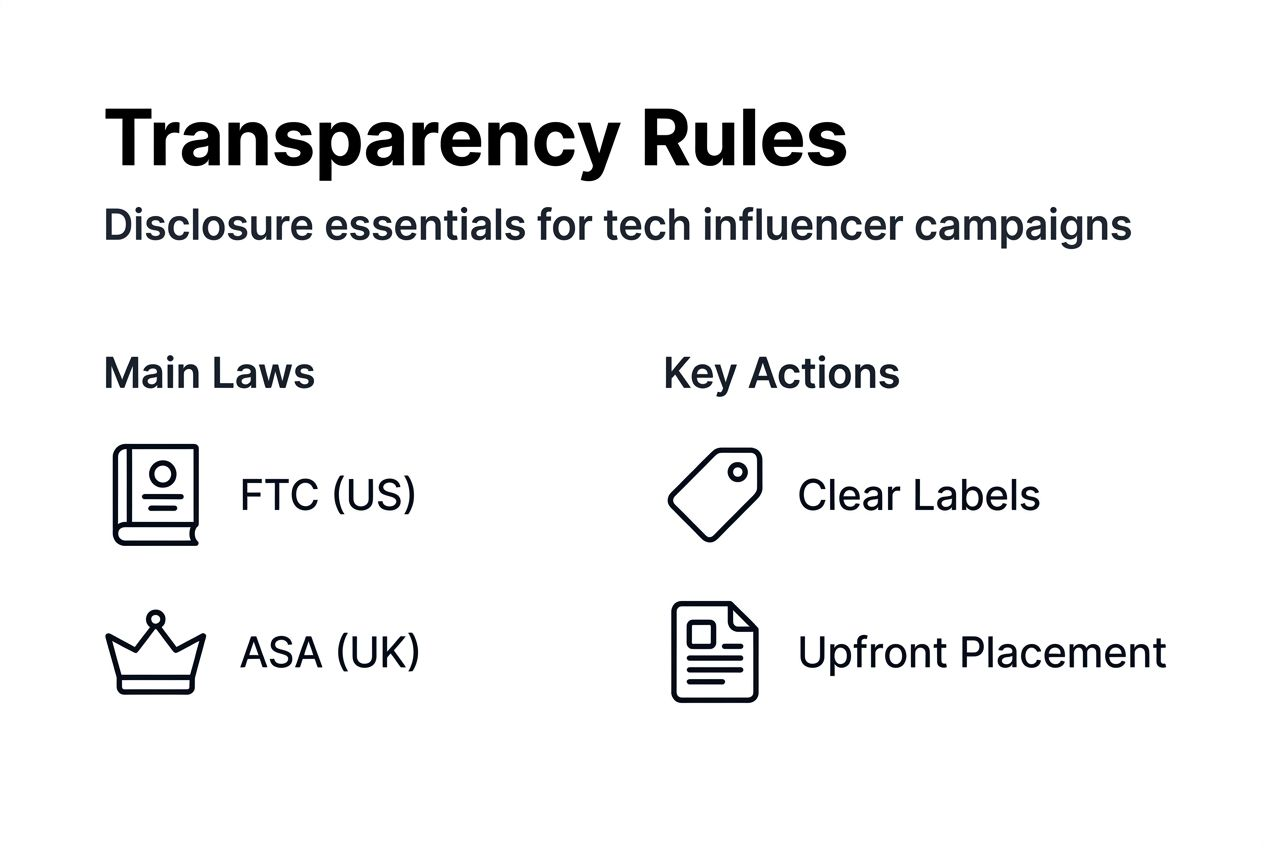
The ASA has similar rules in the UK, emphasizing upfront disclosure placement and unambiguous wording. Global tech brands must navigate additional frameworks in the EU, Canada, and Australia, each with specific requirements for digital advertising transparency. Non-compliance triggers consequences beyond fines: regulatory investigations damage brand reputation, influencer partnerships dissolve, and audience trust evaporates.
| Regulatory Body | Disclosure Requirement | Placement Rule | Penalty Risk |
|---|---|---|---|
| FTC (US) | Clear and conspicuous sponsorship notice | Before promotional content | Legal action, fines up to $50,000 per violation |
| ASA (UK) | Obvious commercial relationship label | Start of content, not buried | Public censure, campaign removal |
| Global Standards | Platform-specific compliance | Visible without scrolling | Reputational damage, market access loss |
Best practices for maintaining compliance across tech markets include these actionable steps:
- Use platform-specific disclosure formats such as Instagram's "Paid partnership" label and YouTube's sponsorship checkbox
- Place disclosures before call-to-action elements so audiences see relationships before making decisions
- Train influencers on regulatory updates through quarterly compliance briefings
- Audit campaign content before publication using compliance checklists
- Document disclosure practices for regulatory inquiries
How transparency builds audience trust and campaign effectiveness
Tech audiences value honesty because their professional decisions carry high stakes. A developer choosing infrastructure tools or a CTO evaluating AI platforms relies on trustworthy information, making sponsorship clarity essential. Transparent sponsorship disclosures can boost audience trust by 70% and improve engagement, metrics that directly influence campaign ROI.
Authenticity perception improves dramatically when influencers disclose partnerships honestly. Technical communities reward influencers who maintain editorial independence while clearly identifying sponsored segments. This authenticity translates to higher conversion rates because audiences believe recommendations stem from genuine product evaluation rather than pure financial incentive.
"Transparent disclosure in influencer marketing can raise audience trust by as much as 70% in tech campaigns, fundamentally changing how technical audiences engage with branded content."
Key mechanisms through which transparency drives campaign success include:
- Enhanced credibility allows influencers to maintain authority when discussing sponsored products
- Reduced skepticism means audiences engage with content rather than dismissing it as advertising
- Community endorsement spreads as transparent campaigns receive positive word-of-mouth
- Long-term loyalty develops when consistent transparency proves influencer integrity
Pro Tip: Integrate transparency into campaign metrics by tracking trust scores alongside traditional KPIs like reach and engagement to demonstrate transparency's business impact.
Common misconceptions about transparency in influencer marketing
Many tech marketers hold beliefs about transparency that undermine campaign effectiveness and ethical standards. Correcting these misconceptions helps teams implement disclosure practices that genuinely build trust.
-
Myth: Minimal disclosures suffice for trust building. Reality shows that unclear or subtle sponsorship disclosures reduce trust by up to 50%, negating potential campaign benefits. Audiences interpret vague language as deception attempts, damaging brand perception more than no disclosure.
-
Myth: Transparency requires oversharing personal influencer details. Transparency focuses specifically on sponsorship relationships and commercial arrangements, not private information. Clear business disclosure satisfies ethical and legal requirements without compromising influencer privacy.
-
Myth: Follower count outweighs transparency in determining campaign success. Data demonstrates that micro-influencers with strong transparency practices often outperform macro-influencers using ambiguous disclosures. Tech audiences prioritize authenticity over reach when evaluating recommendations.
-
Myth: Transparency limits creative freedom in campaign execution. Effective disclosure integrates naturally into content flow, enhancing rather than restricting creative approaches. Influencers who master transparent storytelling maintain audience engagement while meeting compliance standards.
-
Myth: Audiences ignore disclosure statements. Research indicates tech audiences actively seek disclosure information, using its presence or absence to judge content credibility rapidly.
Frameworks and strategies for implementing transparency
A transparency evaluation framework helps optimize sponsorship disclosure clarity and engagement metrics through systematic assessment. The three-pillar approach examines disclosure level (completeness of sponsorship information), clarity (audience comprehension ease), and engagement (how disclosure affects interaction rates).
Implementing this framework involves a five-step sequence:
- Audit existing campaigns to establish baseline transparency scores across disclosure level, clarity, and engagement dimensions.
- Set improvement targets based on regulatory requirements and audience feedback, prioritizing areas with largest trust gaps.
- Deploy AI monitoring tools to track disclosure compliance across platforms in real time, flagging potential issues before publication.
- Iterate disclosure language through A/B testing to identify phrasing that maximizes clarity without disrupting content flow.
- Analyze performance data monthly to correlate transparency improvements with trust metrics and campaign outcomes.
| Evaluation Method | Coverage Scope | Update Frequency | Resource Requirement |
|---|---|---|---|
| Manual Audits | Sample campaigns | Quarterly | High labor, moderate cost |
| AI-Driven Monitoring | All campaigns | Real-time | Low labor, higher initial investment |
Pro Tip: Include transparency KPIs in influencer contracts by specifying minimum disclosure standards and tying bonus compensation to transparency compliance scores.
Continuous improvement demands feedback loops where audience response informs disclosure refinement. Survey tech community members about disclosure clarity, monitor social sentiment around sponsored content, and adjust practices based on quantitative and qualitative insights.

Case studies: real-world examples of transparency success in tech campaigns
An AI software brand achieved a 60% increase in lead quality after improving transparency by redesigning influencer disclosure practices. The company replaced generic "sponsored" labels with specific descriptions of their partnership structure, explaining how influencers tested products independently before endorsement. Lead quality metrics improved because prospects arrived with realistic expectations and genuine interest.
Campaign lifecycle duration extended significantly when brands prioritized transparency. One SaaS company maintained influencer partnerships for 18 months rather than typical 6-month cycles because consistent disclosure built audience trust that sustained engagement. Long-term collaborations reduced acquisition costs and improved campaign efficiency.
Failures related to poor transparency offer cautionary lessons. A hardware brand experienced backlash when influencers used subtle disclosure language that technical audiences interpreted as deceptive. The resulting controversy damaged both brand and influencer reputations, requiring months of remediation efforts.
Key outcomes tech marketers can replicate from successful transparency implementations:
- Clear upfront disclosure increases audience receptivity to sponsored content
- Detailed partnership explanations differentiate authentic reviews from pure advertising
- Consistent transparency practices enable longer influencer relationships
- Proactive compliance reduces legal and reputational risks
- Transparency metrics provide early warning signals for campaign optimization
Conclusion: maximizing ROI through ethical and transparent influencer collaborations
Transparency anchors successful tech influencer campaigns by building trust, ensuring compliance, and driving measurable business results. The strategies outlined in this article demonstrate how systematic transparency implementation transforms audience relationships and campaign performance. Tech marketers who adopt evaluation frameworks, correct common misconceptions, and learn from real-world examples position their brands for sustainable growth.
Measurable business benefits extend beyond immediate campaign metrics. Transparent practices reduce legal exposure, extend influencer partnership duration, and create competitive advantages in skeptical technical markets. As regulatory scrutiny intensifies and audiences demand greater authenticity, transparency shifts from differentiator to baseline expectation.
Adopting continuous improvement mindsets ensures transparency practices evolve with changing regulations and audience expectations, maintaining campaign effectiveness over time.
Enhance your influencer campaigns with expert transparency solutions
Navigating transparency requirements while maximizing campaign impact demands specialized expertise. Corestone Agency delivers tailored solutions for tech brands seeking to implement industry-leading disclosure practices that satisfy regulatory standards and build authentic audience connections. Our services ensure legal compliance across global markets while optimizing transparency for engagement and conversion improvements.
We combine AI-driven monitoring with strategic guidance to help tech marketers implement frameworks that transform transparency from compliance burden into competitive advantage. Contact our team to discover how expert transparency management can elevate your influencer campaigns and deliver measurable ROI improvements through ethical collaboration practices.

FAQ
What are the key regulations influencing transparency in tech influencer campaigns?
FTC rules in the US mandate clear and conspicuous sponsorship disclosures that appear before promotional content, while ASA standards in the UK require obvious commercial relationship labels at content start. Compliance with these regulations reduces legal risks and builds audience trust by demonstrating ethical marketing practices.
How can I measure the effectiveness of transparency in influencer campaigns?
Use trust scores derived from audience surveys, engagement rate comparisons between transparent and non-transparent content, and complaint reduction metrics as primary indicators. AI monitoring tools track disclosure clarity across platforms, while direct audience feedback reveals how transparency affects purchase decisions and brand perception.
What are common mistakes that reduce transparency effectiveness?
Ambiguous sponsorship wording such as "partner" or "collaboration" without clear paid relationship indicators confuses audiences and reduces trust. Neglecting platform-specific disclosure rules or placing notices after promotional claims rather than before them undermines transparency benefits despite technical compliance.
Can transparency impact long-term influencer relationships?
Transparency fosters authenticity that leads to longer, more productive collaborations between brands and influencers by establishing mutual trust. Consistent disclosure practices reinforce audience confidence in both parties, enabling partnerships that extend beyond single campaigns into strategic long-term relationships that reduce acquisition costs.
How does transparency specifically benefit technical audiences?
Technical professionals value analytical rigor and ethical practices in their information sources, making transparency essential for credibility. Clear disclosure allows developers and IT decision makers to evaluate recommendations with full context, improving content usefulness and strengthening influencer authority within technical communities.